Agriculture’s 90% Waste Problem – Two Paths to Innovation in Crop Protection
One of the least discussed challenges in agriculture is the efficiency of conventional spraying systems.
Research suggests that between 60% and 90% of sprayed crop protection products never reach their intended target. Drift, evaporation, poor droplet formation, and uneven canopy coverage mean that a significant proportion of herbicides, fungicides, and insecticides are lost during application.
This inefficiency represents billions of dollars in lost inputs every year and contributes to unnecessary environmental exposure.
As agriculture searches for more sustainable and efficient crop protection solutions, two very different types of technologies are emerging: agricultural robotics and spray optimisation technologies.
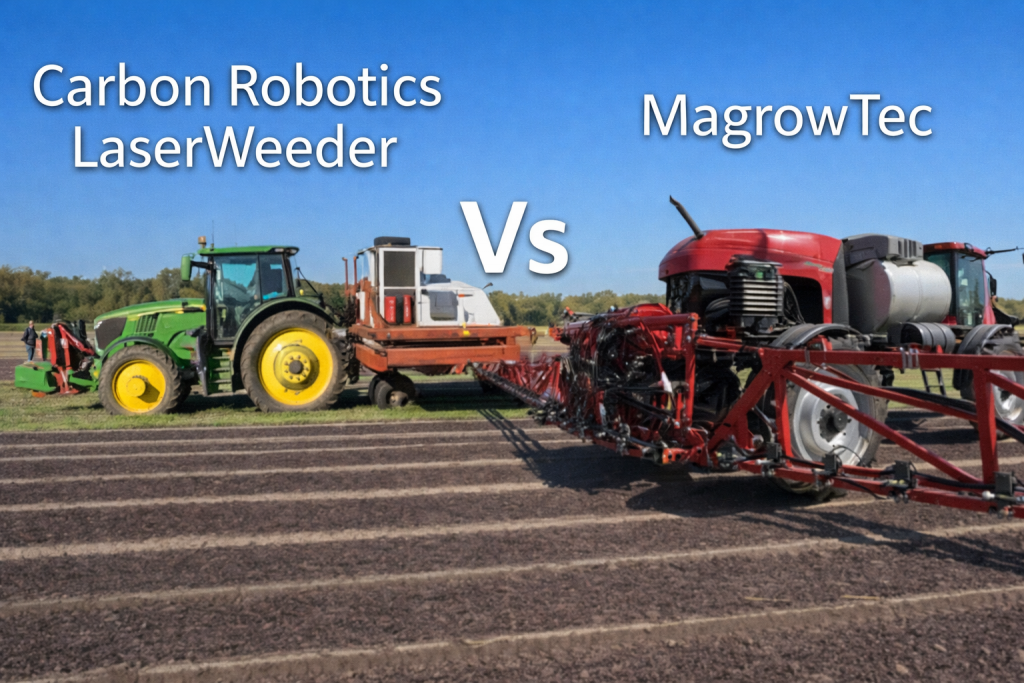
Companies such as Carbon Robotics and MagrowTec illustrate these two distinct approaches. Both represent important innovations in agriculture. Both address real challenges faced by farmers. But they operate in very different parts of the crop protection ecosystem.
Understanding these differences helps illustrate where some of the largest opportunities for improvement may lie.
Two Technologies Solving Different Problems
Carbon Robotics has developed an AI-powered LaserWeeder that uses cameras and lasers to identify and destroy weeds in the field. The technology is primarily designed to replace manual weeding labour and herbicide applications in certain high-value specialty crop systems.
MagrowTec technology takes a different approach.
Rather than replacing crop protection products, MagrowTec focuses on improving how those products are delivered. Installed on existing or new boom sprayers, MagrowTec’s patented magnetic-assist rare-earth spray technology influences the physical behaviour of droplets before they leave the nozzle.
This optimisation of spray performance results in improved spray coverage (20%+), enhanced droplet adhesion, significant spray drift reduction (up to 97.5%) and reduced passes, helping more of the applied product reach and adhere to the intended crop target.
In simple terms:
Robotic weed control technologies focus on replacing manual weeding or herbicide applications in specific crop systems.
Spray optimisation technologies focus on improving the effectiveness of spray applications across a broad range of crops and crop protection products, under real-world speeds and operating conditions.
Both approaches address real challenges in modern agriculture, but they operate at different points in the crop protection process.
The Economics of Agricultural Technology
Another important difference between these technologies lies in their capital structure.
Robotic weed control systems such as laser weeders represent a significant investment. A Carbon Robotics LaserWeeder typically costs around $800k to $1.2 million, requiring a dedicated machine in the farm equipment fleet.
In addition to the machine’s purchase price, there’s an annual cost of ~$70,000 for licensing, personalised support from Seattle, and maintenance for up to 19 weeks. For year-round use, this cost increases to ~$140,000*.
In contrast, spray optimisation technologies such as MagrowTec are designed as retrofit upgrades to existing sprayers, typically 140 ft boom size costing around $54,000. (retail price)
This distinction highlights two different models of agricultural innovation:
High-capital automation systems, designed to replace labour or certain chemical applications.
Efficiency upgrades to existing farm infrastructure, designed to improve the performance of equipment farmers already use.
Both models have roles to play in the future of agriculture, but they scale differently across global farming systems.
Scope of Crop Protection
Another important distinction lies in the scope of the challenges addressed.
Laser weeders focus specifically on weed control. While this can be extremely valuable in certain specialty crop environments, it represents only one part of the crop protection landscape.
Spray technology like MagrowTec, however, plays a role across the full spectrum of crop protection applications, including herbicides, fungicides, insecticides and critically, biologics.
For most farming systems, effective crop protection requires managing weeds, diseases, and insect pests simultaneously. As a result, spray application remains one of the most fundamental operations in global agriculture.
Improving the efficiency of that process, therefore, represents a significant opportunity.
Infrastructure vs Automation
One way to think about this difference is through the lens of agricultural infrastructure.
Sprayers represent one of the most widely deployed pieces of equipment in global agriculture. Every year, hundreds of millions of hectares are treated with crop protection products using boom sprayers across broadacre crops, orchards, and vegetable production.
Because this equipment is already deeply embedded in farming systems, technologies that improve spray efficiency can enhance the performance of existing agricultural infrastructure.
Rather than replacing equipment fleets, spray optimisation technologies aim to upgrade the productivity and sustainability of machinery farmers already own, without creating interoperability issues, technology stack complexity, or second-hand value concerns.
Robotics, meanwhile, represents a different pathway for innovation by introducing new forms of automation to specific agricultural tasks.
Both approaches are likely to play important roles as agriculture evolves.
Enabling the Next Generation of Crop Protection
Another major shift underway in agriculture is the rapid growth of biological crop protection products.
Many biological solutions are contact-based products, meaning their performance depends heavily on spray coverage and effective dose transfer to the plant surface.
Poor application can significantly reduce the effectiveness of these products.
Improving spray droplet behaviour, canopy penetration, and deposition therefore becomes increasingly important as the industry transitions toward lower-toxicity crop protection solutions.
Technologies that optimise spray delivery, like MagrowTec, can help ensure that both conventional and biological products perform consistently in the field.
Built for the Lifetime of the Sprayer
Durability and lifecycle are also important considerations in farm technology adoption.
MagrowTec systems are designed with no moving parts and minimal maintenance requirements, meaning the technology is built to last longer than the lifetime of the sprayer.
Importantly, the system can also be transferred to a new sprayer when equipment is upgraded, allowing growers to continue benefiting from improved spray efficiency across multiple machinery lifecycles.
This makes spray optimisation a long-term infrastructure upgrade, rather than a technology tied to the lifecycle of a single machine.
The Future of Crop Protection
Agriculture will continue to adopt a wide range of technologies to meet the challenges of the future.
Robotics, automation, improved chemistry, digital tools, and enhanced application technologies will all play roles in improving the efficiency and sustainability of crop protection.
But solving agriculture’s spray efficiency problem may represent one of the largest opportunities in modern farming.
If even a small portion of the 60–90% of spray that currently misses its intended target could be redirected to the crop, the economic and environmental benefits would be substantial.
Agriculture will certainly adopt robotics.
But improving how crop protection products are delivered across the world’s existing spray infrastructure may ultimately have an even greater impact.
Because sometimes the most powerful innovation is not replacing the system, but making the system we already have work far better.
Summary

Gary Wickham
Author
-
Gary Wickham is the Chief Executive Officer of MagrowTec, an Irish deep-technology company pioneering magnetic and nano-based solutions for agriculture. Under his leadership, MagrowTec continues to advance science-driven innovation that helps farmers produce more with less — improving productivity while protecting the planet.