
banner

Laser Weed Control vs Smarter Spraying: A 2026 Reality Check from the Field

The future of farming is often portrayed as radical, fully autonomous, and chemical-free. Recently, I read a Future Farming article on laser weeders that sparked a deeper comparison our industry needs to have: laser weed control versus smarter spray-optimisation technologies like MagrowTec.

Both approaches aim to reduce environmental impact and improve efficiency. But in 2026, they are solving very different problems, at very different scales.

The Promise — and Reality — of Laser Weeders

 
https://static1.squarespace.com/static/606b788e71df0270bd2616de/t/6780807c1d7fe058bd2d97a0/1736474757342/LaserWeeder%2BBlue%2BSkies%2B%2B-%2B%2B1%2B-%2BEurope.jpg?format=1500w

Laser weeders are undeniably impressive engineering. Using AI-driven vision systems, they identify individual weeds and destroy them at the growth point using lasers—no chemicals, no soil disturbance. For certain high-value organic crops, this already makes economic sense.

That said, commercial farming today comes with some hard constraints.
1. Economics Still Limit Adoption

  • Capital cost: €600,000 – €1.6 million per unit
  • Ongoing costs: specialist software, AI model subscriptions, GPU power requirements
  • Resale risk: rapid technology shifts (from COâ‚‚ to diode lasers) have already eroded second-hand values

For now, this firmly places laser weeders in the niche category.

2. Speed & Scale Are Major Barriers

  • Typical operating speeds of 0.3–1 mph
  • Reduced effectiveness in dense canopies
  • High accuracy demands flat, stone-free fields

For broad-acre cropping, this simply doesn’t align with operational reality.

3. Biological & Technical Constraints

  • Highly effective on small annual weeds
  • Much less effective on perennials or weeds with underground growth points
  • High energy demand and sensitivity to dust, moisture, and vibration

Laser weeders are powerful—but they are not a silver bullet.

A Different Philosophy: Optimisation Over Elimination

This is where MagrowTec takes a fundamentally different path.

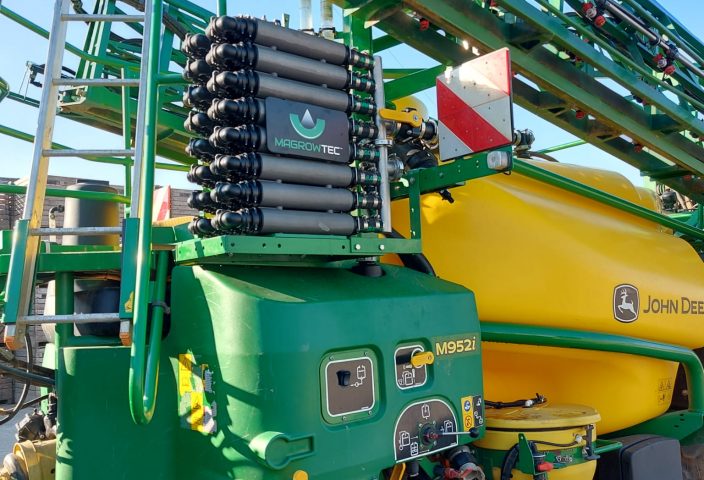
Rather than replacing crop protection chemistry with heat, MagrowTec focuses on making every spray pass work better—across herbicides, fungicides, insecticides, and biological products.

What That Means in Practice

  • 25–50% reduction in chemical and water use
  • 70%+ drift reduction
  • Standard operating speeds (10–15+ mph)
  • Bolt-on retrofit to existing sprayers
  • Zero electronics. Zero moving parts. Zero maintenance.

This isn’t future technology—it’s delivering results on farms today.

Why Speed, Scale & ROI Matter

A single MagrowTec-equipped sprayer can:

  • Halve water application rates
  • Double the acres covered per day
  • Reduce—or eliminate—the need for a second sprayer
  • Deliver ROI in under 12 months

By contrast, laser weeders often require new platforms, new skillsets, new power systems, and new risk profiles.

Beyond Herbicides: The Biologics Advantage

One critical distinction is often missed in this debate:

Laser weeders only address weeds.
MagrowTec improves the performance of all crop protection products.

As agriculture shifts toward lower-toxicity biologicals, coverage and adhesion become everything. These products fail if they drift, evaporate, or bounce off the leaf.

MagrowTec excels here—enhancing under-leaf penetration, adhesion, and consistency in ways conventional spraying struggles to achieve.

So… Which Technology Wins?

That’s the wrong question.

Use laser weeders if:

  • You grow high-value specialty or organic crops
  • Hand-weeding costs exceed €1,000 per acre
  • Speed and acreage are secondary concerns

Use MagrowTec if:

  • You farm at commercial scale
  • You want immediate reductions in cost, water, drift, and labour
  • You need solutions that work across all spray applications, not just weeds

The Real Future of Farming

The future isn’t about choosing radical vs conventional.

It’s about deploying the right technology, at the right scale, with real-world economics.

Laser weeders will continue to evolve—and they absolutely have a place. But in 2026, the fastest path to sustainability, profitability, and reduced chemical impact is not elimination alone.

It’s making every drop count.

Picture of Gary Wickham

Gary Wickham

Gary Wickham is the Chief Executive Officer of MagrowTec, an Irish deep-technology company pioneering magnetic and nano-based solutions for agriculture. Under his leadership, MagrowTec continues to advance science-driven innovation that helps farmers produce more with less — improving productivity while protecting the planet.

VISIT US AT BOOTH 17 AT THe 2022 Australian COTTON CONFERENCE